
65th (2nd Yorkshire North Riding) Regiment of Foot

65th (2nd Yorkshire North Riding) Regiment of Foot |
|
Here is a potted history of the 65th in New Zealand. Also included is a summary written by New Zealand historian and collector, Tim Ryan. For in-depth histories of the New Zealand Wars, check out the books listed in my bibliography.
The 65th Regiment had the distinction of being the longest serving British infantry regiment serving in New Zealand, stationed here from 1846 to 1865.
“The men of the 65th who paraded were shaggy, bearded giants, roughly clad, with their arms in excellent order.”
“The 65th man was a breezy, brawny giant, who moved about in loose clothes, open, chatty, and good-natured. He got blazing drunk whenever the opportunity offered, took his punishment as if it were a cup of coffee, was a perfectly wholesome child of nature, who laughed and shook hands with every one he met. He was perfectly respectful to his officer, saluted him reverently with a twinkle in his eye, as though he would say “How goes it, Charley?”
“Their appearance is very different from that of the men belonging to others recently arrived. They are grave, serious, thoughtful men, with bronzed faces and flowing beards - living proofs of the healthiness of the climate. They are all in good condition, and occupy one fourth more space on the parade-ground than any other regiment here.”
Nicknames
The regiment's
official nickname was the "Royal Tigers", earned from
their service in India, and the regimental badge. The Maori
called the regiment the "hickety pips" after the Maori
pronunciation of 65th -"hikete piwhete".
Bugle Call
This bugle call I found in Trumpet and Bugle Sounds for the Army, 1927. It is the call for the 1st Battalion, York & Lancaster Regiment. As this is the direct descendent of the 65th Regiment, I would guess that this is the call used during the 1860s.
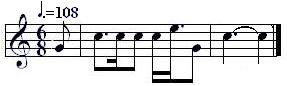
Click on the score to hear a synthecised version of the call (on a trumpet, as the composer program had no bugle).
Colours
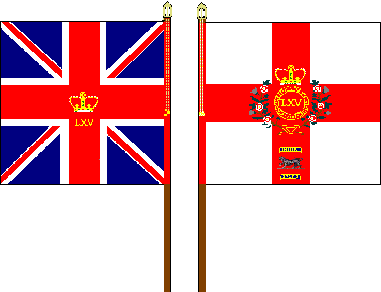
I have done some research into what the Royal (designated Queen's after 1878) and Regimental Colours looked like at this time. Below are drawings of
what I believe them to have been. The regiment had gained the honours 'India'
and 'Arabia'. They had also done service in Guadaloupe during the Seven Years'
War, but this honour was not awarded till 1909. (Click on each flag for detailed
view)
Arrival in New Zealand
The Regiment, during August 1845 to May 1846, provided convict guards on six ships from England to Hobart Town in Van Diemen's Land (Tasmania) and two to Norfolk Island, delivering the convicts before continuing to Sydney. When disturbances broke out in the Wellington area, most of these men from the 65th and the 58th Regiments were shipped to Wellington on the Levant, arriving on 22 July 1846 (65th - 5 officers, 58th - 1 officer.
8 sgts, 7 cpls, 162 rank & file of both regiments).
During the period August 1845 to May 1846 the Regiment departed Woolwich and was shipped to Sydney, via Hobart on the following ships - Samuel Boddington, Pestonjee Bomanjee, Joseph Semes, Palmyra, Lord Auckland, Maitland, John Calvin, China, and Java.
The Java was rechartered to carry the Regiment to New Zealand, departed Sydney 8 November 1846, disembarked 2 companies (200 men) in the Bay of Islands 19 November 1846, before continuing to Auckland with the remainder, arriving on 22 November 1846.
Owing to an outbreak of measles amongst the children at the Chatham depot, no married officers or soldiers were allowed to embark on the Java. They (including commanding officer Lieut. Colonel Gold) followed on the Sir Robert Peel, which departed on 19 September 1846 and arrived in Auckland 14 January 1847.
During the period 1847 to 1864 reinforcements were shipped to New Zealand on the following ships - HMS Calliope, Egmont, Euphrates, Lanchashire Witch, Spirit of Trade, Sir George Pollock, Chariot of Fame, Nelson.
Refer to Ships carrying Regiment to Australia & New Zealand for details.
Dispositions
The Regiment spent much of its
time split up by companies around the North Island.
See Dispositions of the 65th Regiment in New Zealand for the annual returns, as listed in the regimental diary.
The first two companies to arrive in New Zealand took part in the last engagement of the 1st New Zealand War at Horokiri, north of Wellington, in August, 1846. On 1 August 1846, 5 officers, 7 sergeants, 142 rank & file arrived at Porirua from Wellington on H.M.S. Calliope.
Further reinforcements were sent to Wellington in December 1846. On the 19th H.M.S Driver arrived from Auckland carrying Ensigns Barton and Thelwall, Dr. Prendergast, 2 sergeants and 130 rank & file, under the command of Captain Johnson, followed five days later by H.M.S. Racehorse with Lieutenant Gordon, 1 sergeant and 30 men.
Owing to an attack on a small garrison of the 58th Regiment in Wanganui and the murder of Mr Gilfillan’s family, the Grenadier Company of two officers and 100 men, under the command of Captain Wolfe, was dispatched from Auckland on H.M.S Inflexible, arriving 24 May 1847. The warship then proceeded to Wellington, where it embarked a company of two officers and 116 men, under the command of Captain O’Connell. A part of this force had been stationed at Fort Richmond at the Hutt bridge under Capt. O'Connell, and the remainder of the company had been employed as a road party on the Porirua road under Lieutenant M'Coy. The ship departed for Wanganui on 3 June. These two companies took part in the Battle of St. John's Wood, near Wanganui, 20 July, 1847.
The Headquarters re-located to Wellington from Auckland in 1847, arriving 7 August on the Pestonjee Bonmanjee, an advance party detachment having arrived on the Thomas Lowry on 23 July.
On 19 October 1847, the detachment remaining in the Bay of Islands, of two companies of 4 officers (Young, Elwes, Slegg, Park), 10 sergeants, 1 drummer, and 202 rank and file, under the command of Major Patience, embarked on board the Thomas Lowry, arriving at Wellington on 29 October.
On 13 November 1847, the Light Company, including Capt. O'Connell (returning from leave), Mrs. O'Connell and child, Mrs. Wyatt and child, Lieuts. Cuthbert and Macgregor, Ensign Thelwall, and Assistant-Surgeon Park, departed Wellington on board the Eleanor Lancaster for Wanganui, to relieve the detachment of the 58th Regiment and reinforce the detachment of the 65th Regt. already there. The ship was also carrying a detachment of the 58th Regiment, bound for Auckland. Arriving at Wanganui on the 18th, this completed the division of garrison duties in the North Island, with the 58th Regiment in the north and 65th in the south.
On 11 April 1848, 2 officers and 50 rank & file departed Wellington for Wanganui on the Scotia.
In 1850 the Regiment was in the Wellington area, about half in Wellington and the rest in nearby Porirua.
In August 1850, orders were received from Horse Guards for a Depot Company to be formed in England, and for service companies to be reduced to six.
In September 1850, it was reported – “The following reduction of the troops, in accordance with the orders recently received from the Horse Guards has taken place in the Province of New Munster [North Island]:— On the 31st ult., 25 privates were discharged from the 65th Regiment, in addition to one corporal and 14 privates who had been previously transferred from the 58th to the 65th, on the embarkation of Capt. Russell's company for Auckland; making a reduction altogether of 1 corporal and 39 privates. We also understand that a reduction by instalments of about 30 men per month will take place between Wellington and Wanganui. A skeleton company is also about to embark on board the Fairy Queen for England, via Auckland consisting of Brevet Major Johnson, Ensign Ewen, Assistant Surgeon Park, 4 serjeants and 4 corporals, and we hear that the two remaining skeleton Companies under the command of Major Wyatt consisting of Capt. Newenham, Lieut. M'Gregor. Ensign Barton, 8 Serjeants, 8 Corporals will embark for England as tonnage offers. One serjeant and 19 privates will proceed home by the Fairy Queen as invalids.” The Fairy Queen subsequently departed Auckland on 30 October, including three officers and 28 rank and file of the 65th Regiment on board.
On 6 September 1855, a detachment of 6 officers, 210 non-commissioned officers and men, Major G F Murray commanding, arrived at New Plymouth from Wellington on the Duke of Portland.
When the 99th regiment departed Australia in 1856, 139 men of the regiment chose to transfer to the 65th Regiment, arriving in New Zealand on the Southern Cross 11 February 1856.
In 1858, in response to inter-tribal fighting, a detachment, commanded by Brevet Lieut. Col. Wyatt, was dispatched to Napier from Auckland, arriving 7 February on board the Eastfield, followed by three detachments from Wellington on the Wonga Wonga, arriving 26 February, 18 March and 25 March.
On 5 April 1858, 1 officer and 45 men departed Auckland for Wellington on the Kate Kearney, via New Plymouth. The ship did not leave until 14 April 1858, now carrying 1 officer and 51 men.
Also in this year, in anticipation of the 58th Regiment’s departure from the country, the regimental Headquarters moved from Wellington to Auckland, arriving on 4 October on the ships: Moa, Sarah, and City of Melborne, followed on 21 October by the the Emily Allison from Wellington and the Henry from Napier.
During the Taranaki War of 1860-61, there were about 700 of the Regiment, including the Headquarters, in Taranaki.
On 12 October 1860, Lieut.-Col. Wyatt arrived at New Plymouth from Wellington and took command of the regiment from Colonel Gold, who had been promoted to Major General on 15 June and retired from command of the 65th on 1 October.
In early January 1861 the entire regiment
The 65th on parade, New Plymouth,
Taranaki, March 1861
Alexander Turnbull Library - PA1-q-250-04
The regiment departed Taranaki for Auckland on two sailings of H.M.S.S Niger and one of H.M.S.S Fawn on 16th and 20 April 1861.
“The 65th Regiment has left for Auckland. Report speaks of a grudge on the part of this corps towards the settlers of Taranaki. We speak the voice of most of our neighbours in saying that the greatest good will exists on the side of the civilians. During more than five years a detachment of the Regiment has been quartered here, and it has been simple justice to say that so orderly, sober, and respectable a body of men is seldom met with in any condition of life. Whenever the return of peace allows of the discharge of those of whose term of service has expired, they will be especially and heartily welcomed back as settlers.”
The entire regiment was concentrated in the Albert Barracks, Auckland, except for 84 men in Taranaki.
During 1861 and 1862 the regiment was engaged in road building, along with the other regiments in the country, building the Great South Road south from Auckland, in preparation for the invasion of the Waikato.
On the evening of 29 January 1862, Assistant Surgeon A. H. Neill, while walking between and 65th Regt. camp and the 70th Regt. camp beyond Drury, was robbed and stabbed in the chest by a masked attacker. A corporal and four privates of the regiment pursued three men to the Royal Artillery camp within the 70th camp. Lieutenant Talbot and Ensign Butler apprehended the suspects after finding an envelope belonging to Neill on the man suspected of stabbing him. Dr White treated the dangerous wound that perforated his left lung, fearing at the time that it was fatal. The three men of Captain Mercer’s battery were charged with stabbing with intent to murder, but were acquitted in the trial due to lack of positive identification of the attacker . Assistant Neill survived, but was invalided to the U.K. to recuperate.
On 4 June 1863, the detached company that had remained in Taranaki from 1861, under Captain Gresson, was involved in the assault of Katikara Pa, Taranaki.
This was followed by a period of aggressive patrolling and bush scouring. “June 10 [1863]. — Two parties — one of the 65th, under Captain Gresson, and Captain Atkinson's party of Volunteer — started at an early hour this morning to surprise the natives reported to be at Smart's farm. The picket at Fort Niger observed torch lights moving in the direction of the bush during the early part of last night, but no natives were discovered by either Captain Gresson's or Captain Atkinson's party, and they returned to town after searching the bush in all directions. June 22 - Captain Gresson's party of volunteers from the 65th, and also Captain Ralston's from the 70th, together with Captain Atkinson's Volunteers, daily beat the forest in all directions, while the 57th do their share at Poutoko and Oakura, but the 'wily negro' is none est.” (Taranaki Herald, 29 June 1863.)
The Taranaki detachment finally rejoined the Regiment on 28 June 1863, arriving at Auckland on H.M.S.s. Eclipse.
The Regiment took part in the invasion of the Waikato in July 1863. The regiment’s first task was to occupy Tuakau on 13 July 1863 and build a redoubt overlooking the Waikato River, a task completed by 250 men in four days. This was named the Alexandra Redoubt, in honour of Princess Alexandra of Denmark, who had married Albert, Prince of Wales, the future King Edward VII, on 10 March 1863.
In a newspaper article dated 28 July, it was reported that: “The Alexandra redoubt at Tuakau has been finished under the direction of Captain [Richard] Swift, 65th Regt., who commands the troops at this post. All the canoes about the neighbourhood have been seized by his order, and a regular Naval Brigade has been formed, consisting of about 40 men. By these means the Commandant has obtained complete command of the river. On the 27th a force of 60 men, commanded by Captain Swift, with Lieut. [Villars] Butler, crossed the Waikato [river]. This, I believe, is the first time our troops have crossed it. All the arrangements were so well carried out that the whole force landed in half an hour, crowned the hills on the other side, and skirmished through four miles of bush in first-rate style. They returned to the Redoubt, the settlement being entirely deserted on the advance of the troops. The force at this post, under its present commander, is fit to perform any duty required of it.”
On 22 July, 1863 at Kiri-Kiri on the Great South Road about half way between Auckland and the Queen’s Redoubt, there had been a skirmish in which 6 officers and 81 men, under Lieut. Col Wyatt, were part of the force engaged. 1 man was killed.
On 7 September, 1863, the commissariat supply dump, run by a Mr Armitage and a party of friendly natives, down river from the Alexandra redoubt at Cameron Town was attacked by a large raiding party. See under Battles for details.
It was reported that on October 21 1863 the “Flying Column” based at Drury included 50 men of the regiment, under Lieut. L. S. Warren.
At Rangiriri, on 20 November, 1863, 10 officers and 376 men, under Lieut. Colonel Wyatt, were present. See under Battles for details.
On 8 December the Union Jack carried by the regiment was hoisted on the flagstaff of the Maori king at Ngaruawahia. This was the same flag they had carried in battle at Rangiriri, as they had been ordered to leave their Colours in Auckland.
The regiment advanced up the Waipa river with Cameron's main field force. On 26 January 1864, it was reported from Tuikaramea camp that “About nine o'clock 100 rank and file, 5 sergeants, and 2 drummers, of the 65th Regiment, commanded by Lieut. Wrixon and Ensign Spiller, left this camp for Whatawhata, where it is intended a force of 200 men, in command of Colonel Murray, shall remain in charge of the stores deposited in that place until communications can be again safely had with the advanced post now proposed to be taken up”. This left the following officers and men remaining at the camp, forming part of the force massing for the advance to the Paterangi line – 65th Regiment, commanded by Colonel Young; Captains Blewitt, Gower, Higgin; Lieutenants Pennefather, Pagan, Tabuteau, and J. W. Lewis, Ensigns Chaytor, and Heyland; Dr. White, Quartermaster Purcell, 231 rank and file, 13 sergeants, and 7 drummers , total, 251.
A large number of the regiment were was present at Rangiaowhia, 21 February, 1864 and Hairini, nearby, the next day. See under Battles for details.
At Orakau Pa, 30 March - 2 April, 1864, the final battle of the Waikato war, 9 officers and 238 men of the regiment were present. Ensign Alfred Chaytor died at Te Awamutu of wounds received in the battle.
At Gate Pa, Tauranga, 20 April, 1864 - one detached company of the regiment (No. 3, under Capt. L. S. Warren), forming part of the 'Moveable Column' consisting of men from the 12th, 14th, 40th, 65th and 70th Regiments, took part in the disastrous battle. One man of the regiment was wounded.
On 19 August 1864 the moveable column was broken up, “owing to the natives having entirely disappeared from the vicinity of the outposts” and No. 3 Company rejoined the Headquarters.
The regiment did not take part in General Cameron’s Wanganui campaign of 1865, apart from Cameron’s Aide de Camp, Lieutenant St Hill, as well as eight men attached to the Commissariat and Land Transport Corps.
Click on the link for a list of details of Officers of the 65th in New Zealand I have been compiling.
Battles
The first two
companies to arrive in New Zealand took part in the last
engagement of the 1st New Zealand War at Horokiri, north of
Wellington, in August, 1846.
Two companies took part in the Battle of St. John's Wood, near Wanganui, 20 July, 1847.
Various companies of the regiment took part in nearly every battle and numerous skirmishes in Taranaki 1860-61 (2nd New Zealand War), notably:
On 4 May 1863, a detached company was involved in the assault of Katikara Pa, Taranaki.
The Regiment was heavily engaged in the invasion of the Waikato 1863 - 64 (3rd New Zealand War), notably:
I have compiled a detailed list of 65th Regiment officers and men involved in battles in New Zealand.
Click on the map of the North Island showing the principal engagements in the New Zealand wars 1845-1872.
Respect between
Enemies
There was reportedly
a strong respect and chivalrous, almost friendly behaviour
between the 65th Regiment and the Maori. No such respect existed
for some other units, e.g. the 70th being taunted to "Go
back to India". The Forest Rangers were particularly
disliked, probably due to their use of guerilla tactics, which
offended the Maori warrior code.
“On my return to No. 6 [Redoubt], I found the Redoubt crowded with Maori men and women, heavily laden with peaches, melons, potatoes, pigeons, and other presents for the " Hikity-Fift," with whom they were fraternizing with the utmost cordiality and confidence — a cordiality by no means so conspicuous with the other corps.” ( The Waitara and the War from a Civil point of View” - from the New Zealander - April 6. – Taranaki Herald, 20th April 1861 – p. 4)
As described in The York and Lancaster Regiment, Vol 1, p 112, when pickets from the 65th went into the bush at night, they would identify themselves to the Maori and ask them if there would be fighting that night. If the reply was something like "Not tonight - too wet and cold; we’d better get some sleep. Good night, Hickety Pip." both sides would honour the agreement. If there was going to be an attack, they would be given warning, then be expected to fight like any other regiment.
On other occasions, during a lull in fighting, there would be a temporary truce and the Maori and men would exchange food and tobacco and the Maori would point out where they had carefully buried and neatly fenced off, the bodies of 65th men.
On another occasion, when the 65th led an assault on a pa, a Maori shouted out for the Regiment to lie down, because they wanted to fire at the following regiments. The request was ignored.
The respect of the regiment for their enemies was such that a memorial plaque, with the following inscription, was placed in St John's church, Te Awamutu:
THIS TABLET I SAY UNTO YOU, LOVE YOUR ENEMIES. |
Return to England
The Regiment embarked
for England from Auckland in two ships - the Rob Roy on 7 October,1865, carrying 3 officers, 199 other ranks, 12 women, 21
children; the John Temperley on 24 October,1865, carrying 13 officers,
170 other ranks, 14 women, 32 children. Interestingly, this
comprises a total of less than half the nominal strength of the
Regiment. However, by 1 January 1865 the actual strength of the regiment in New Zealand was 779, all ranks, further reinforced by the arrival of 2 officers and 65 men on the Nelson.
Over the time the regiment served, over 1100 men retired from the ranks and settled here. Many then served in the Colonial militia and volunteer units. One such officer, Captain George Buck, commanded the Wellington Rangers and was killed at Te Ngutu O te Manu in 1868. Ensign Edward McKenna VC, served briefly in the famed Forest Rangers in Taranaki until its disbandment in 1867. Quartermaster Edward Withers, after his retirement, eventually became a Major in the New Zealand Militia, commanding the Auckland district. For more information, see the list of details of Officers of the 65th in New Zealand.
British Units that served in New Zealand
Colonial Forces of the Period 1840 - 1865
Militia Units were conscripted for local defence within 25 miles of their homes, whereas volunteers generally received higher rates of pay and often confiscated land.

 Return to top of page |
 Return to Home Page |
Updated 18 February 2021